
Ukraine is already in a position to provide the European Union with solutions to a significant share of its technology dependencies. This is confirmed by the findings of the EU-Ukraine Digital Sector Interlinkages Report, prepared by a consortium of Ukrainian and European IT clusters within the ITBridge project.
For the first time, the EU’s list of critical technology dependencies has been matched against the real capabilities of Ukraine’s IT sector. The result shifts the framing of the discussion: Ukraine is not a “promising” partner, but a ready technology partner for the EU, able to offer solutions in critically important areas, including security.
Why this matters now for the EU and Ukraine
The European Union is investing billions of euros to reduce its technology dependence on the United States and China, including through the European Chips Act, Big Tech regulation, and support for domestic manufacturing and innovation. At the same time, most of these initiatives have a long-term implementation horizon.
The ITBridge study highlights an alternative that is available today: across nine technology areas where the EU relies on non-European suppliers, Ukrainian companies already have export-ready solutions. For business, this is a clear signal — demand is in place, market-entry tools exist, and the window of opportunity is open.
What kind of technology partners is the EU looking for?
The European Union’s push for digital sovereignty is driven by its reliance on non-European technologies. This creates a clear demand for reliable technology partners.
For the study, an expert focus group was formed: 33 specialists from 31 organizations. It included leaders and representatives of IT clusters, industry clusters, business support organizations, and technology companies from 11 EU countries (Belgium, Estonia, Spain, Italy, Latvia, Germany, Poland, Portugal, Romania, Hungary, and Croatia).
Critical technologies for the EU: two groups identified by experts
- Big Data & Analytics, Cloud, Edge & Fog Computing, Cybersecurity, IoT & Embedded Systems, and Semiconductors & Microelectronics are recognized as critical for the EU’s security.
- Web Platforms & Applications, AI & ML, AR/VR/XR, 5G & Next-Gen Connectivity, Quantum Technologies, Unmanned Vehicles, Robotics & Automation, and Enterprise Process Automation are identified as areas that pose risks to the competitiveness of the economy.
According to the ITBridge study, Ukraine can be a partner for the EU in nine of these areas: Big Data & Analytics, Cybersecurity, Cloud, Edge & Fog Computing, IoT & Embedded Systems (security-critical), as well as Unmanned Vehicles, Web Platforms & Applications, AI & ML, Enterprise Process Automation, and Robotics & Automation.
What Ukraine brings to the table: key figures and what they mean
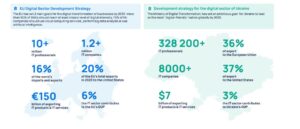
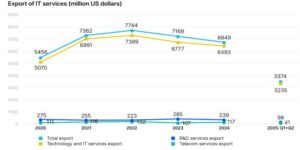
$6.8 billion in IT services exports in 2024. This represents 37.7% of Ukraine’s total services exports and is the country’s largest service industry. For European businesses, it signals a mature market where companies are used to working internationally and the “first-mover” risk is minimal.
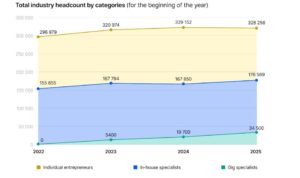
328,000 technical specialists and 20,000+ graduates every year. This talent pipeline enables projects to scale: if a pilot succeeds, there is sufficient capacity to roll it out.
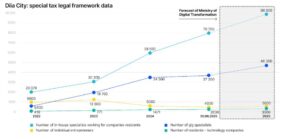
Diia City, with residents such as Samsung, SAP, Visa, and Nokia, offers a regulatory environment that has been validated by global players. A competitive tax regime and common-law-based legal instruments make the rules clear and predictable.
93% of companies operate in international markets. This is a key indicator, as there is no need to train a partner to work with foreign clients — processes, standards, and communication practices are already established.
Where the opportunities for partnering with Ukraine are
The study identifies two levels of capability. The first includes areas where Ukraine is a global leader with unique expertise.
- Unmanned Vehicles. Aerial, ground, and maritime drones. This expertise has been built in real-world operational conditions. For the EU, which has included unmanned systems among its technology dependencies, Ukraine is a ready partner with practical experience that cannot be replicated through lab-based development alone.
- Web Platforms & Applications. A mature ecosystem for building complex digital products, from services to full-scale platforms.
The second level includes areas with a deep talent pool and proven experience in international projects:
- AI & ML — computer vision, NLP, intelligent automation.
- Big Data & Analytics — data warehouses, analytics systems, BI tools.
- Cloud, Edge & Fog Computing — scalable infrastructure for business.
- IoT & Embedded Systems — solutions for AgriTech, manufacturing, logistics.
- Robotics & Automation — from production lines to business processes.
- Blockchain & Distributed Ledger — decentralized transactions and data governance.
- Cybersecurity. Ukraine repels state-level cyberattacks on a daily basis. This resilience expertise is a unique value proposition for European businesses and governments.
All of these areas are included in the EU’s list of technology dependencies and are already represented by Ukrainian companies in international markets.
How to enter the EU market: market-entry tools that already work
A key value of the study is that it systematizes practical, working tools for entering the EU market rather than relying on declarative initiatives.
For business
- Ukraine has obtained full access to the Single Market Programme, meaning Ukrainian companies can participate in European initiatives on the same footing as companies from EU Member States. This opens access to a market of 450 million consumers.
- The Horizon Europe and Digital Europe Programme provide access to multi-billion-euro EU budgets that fund joint R&D projects, innovation, and digitalization. Ukrainian companies can join consortia and receive direct funding.
- Enterprise Europe Network (EEN) is the world’s largest business support network. It helps companies find international partners, enter new markets, and integrate into European supply chains.
- The network of European Digital Innovation Hubs (EDIH) includes six hubs operating in Ukraine. They offer SMEs a full suite of services: testing new technologies, access to training programs, and support in finding European partners. In practice, this acts as a one-stop shop for Ukrainian SMEs planning technology cooperation with the EU.
For clusters
- European Cluster Collaboration Platform (ECCP) is a platform for finding partners among European clusters, entering new markets, and integrating into European value chains.
- EU-Ukraine Cluster Partnership Programme provides direct funding for cooperation projects between Ukrainian and European clusters. The ITBridge project, which produced this study, is implemented within this programme.
For european business: partnership, not outsourcing
The study presents a model that goes beyond traditional outsourcing. It focuses on co-development: joint innovation, shared intellectual property, and long-term partnerships.
For European companies looking for alternatives to reliance on US or Chinese suppliers, Ukraine is a partner with access to the same EU programmes, a transparent regulatory environment, and capabilities precisely in the areas where Europe needs additional strength.
Read the full text of the report👇
The EU–Ukraine Digital Sector Interlinkages Report was prepared by a consortium comprising Kharkiv IT Cluster, Odesa IT Family, Transilvania IT Cluster (Romania), Cluster Digital de Catalunya (Spain) and Dnipro IT Community as part of the ITBridge project – a strategic initiative to strengthen EU-Ukraine cooperation in the digital sector.
The ITBridge project is funded by the European Union through the Single Market Programme (grant agreement №101196018). The views and opinions expressed in this report are solely those of the authors and do not necessarily reflect the position of the European Union, the European Innovation Council, or the EISMEA Executive Agency.


