

- This event has passed.
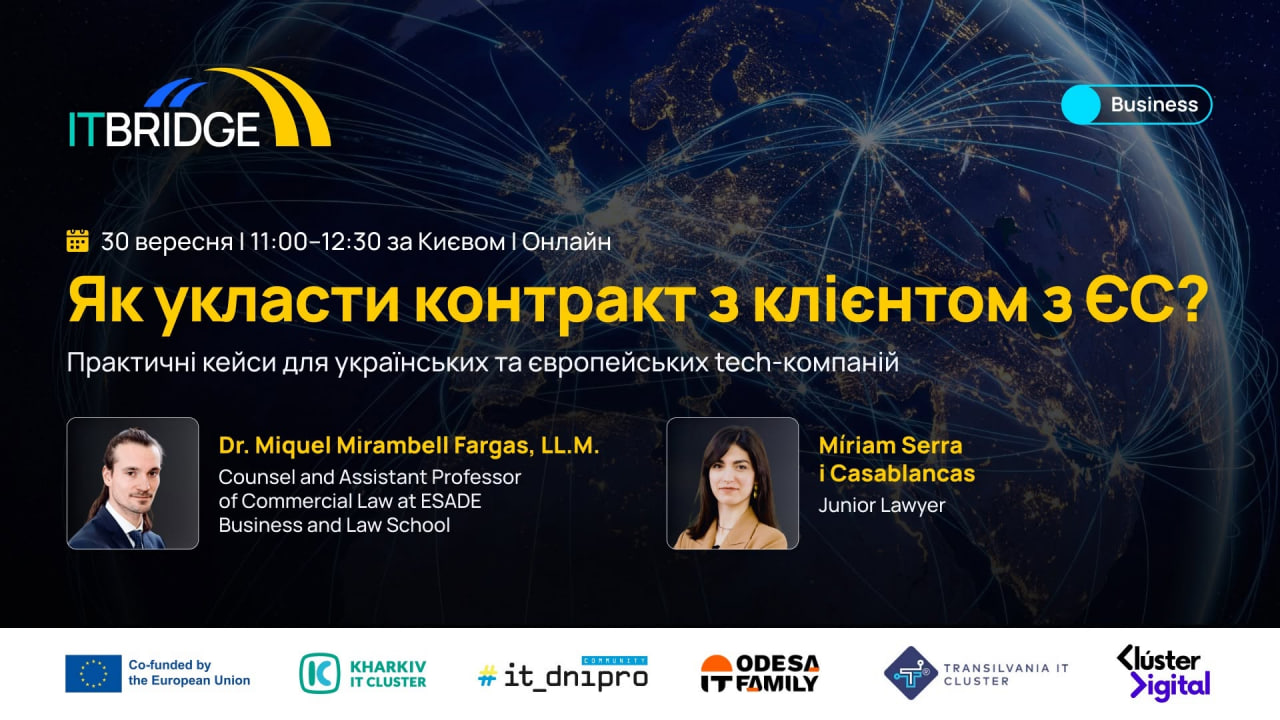
How to sign a contract with an EU client?
🇪🇺 A contract with an EU partner is more than just a signature. It is a tool for managing business risks.
For a Ukrainian IT company, entering the European market does not end when a client says “yes.” The next step is the contract — and a single overlooked clause can affect payments, ownership of your product, your company’s liability, or your ability to protect your interests in the event of a dispute.
Who owns the IP? What happens if the client delays payment? Where will disputes be resolved? What liabilities are you taking on? What data protection requirements should you consider?
At the 7th Go-To-Market Bootcamp session, we will explore B2B contracts with European partners through a practical case study.
📅 September 30 | 11:00–12:30
💻 Online | Free of charge
👉 Registration: https://forms.gle/2Gc7GStrC3V1JyKC9
During the session, we will cover:
⚡️ Key provisions of B2B service agreements
⚡️ Intellectual property: ownership and licensing
⚡️ Liability, risk allocation, and protection mechanisms
⚡️ Data protection and regulatory compliance
⚡️ Governing law and dispute resolution
⚡️ Contractual risks and practical recommendations
🎤 Speakers:
👤 Dr. Miquel Mirambell Fargas — Legal Counsel and Associate Professor of Commercial Law at ESADE Business and Law School.
👤 Míriam Serra i Casablancas — Junior Lawyer.
The session draws on three years of practical experience advising on B2B agreements between the Spanish subsidiary of a leading German retailer and its suppliers.
If you are a Ukrainian company already working with EU clients or planning to enter the EU market, this session will help you better understand what to review, negotiate, and clarify before signing a contract.
👉 Join us: https://forms.gle/2Gc7GStrC3V1JyKC9
The programme is organised by Kharkiv IT Cluster, Odesa IT Family, Transilvania IT Cluster, Cluster Digital de Catalunya, and Dnipro IT Community within the ITBridge project — a strategic initiative aimed at strengthening cooperation between the European Union and Ukraine in the digital sector.
The ITBridge project is funded by the European Union under the Single Market Programme pursuant to Grant Agreement No. 101196018. Views and opinions expressed are, however, those of the author(s) only and do not necessarily reflect those of the European Union or the European Innovation Council and SMEs Executive Agency (EISMEA). Neither the European Union nor the granting authority can be held responsible for them.


