
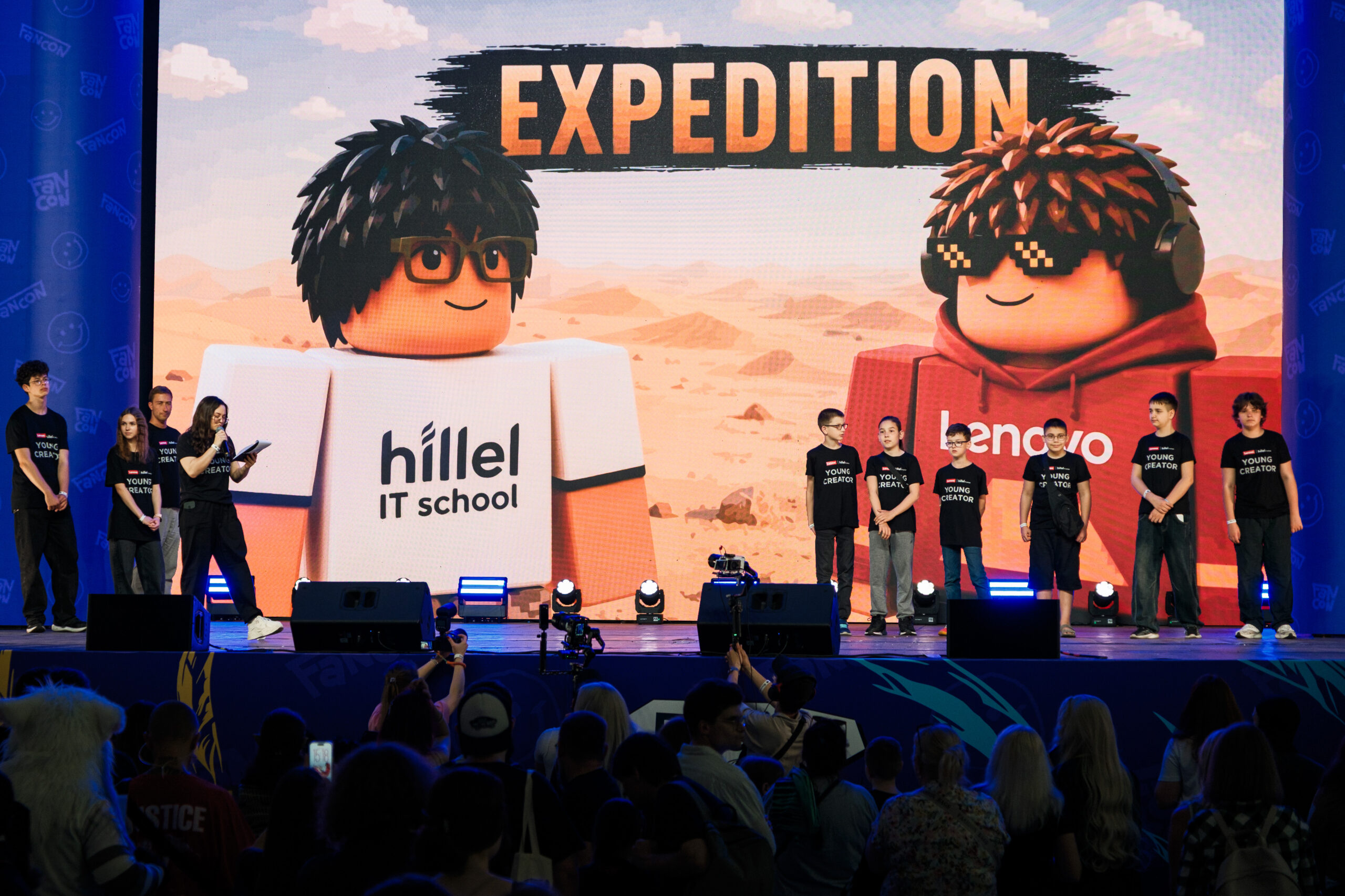
Eleven students, seven months of work, and a fully developed game on Roblox – that is the result of a joint project by Lenovo and Hillel IT School. The participants, aged 9 to 16, went beyond completing learning assignments and worked as a team to build a real digital product: writing code, creating 3D assets and animations, testing the game, fixing bugs, and meeting deadlines.
Lenovo supported the game’s development, with its brand integrated directly into the game world and gameplay mechanics. Hillel IT School brought together graduates of its game development and 3D modeling courses and organized the development process. The finished game was presented at FANCON, Ukraine’s largest pop culture festival.
Eleven Students, One Development Team
The participants live in different cities across Ukraine, as well as in Poland, Bulgaria, and Norway, so the entire project was developed remotely.
The workflow was designed to mirror the way professional tech teams operate as closely as possible. The students held regular meetings on Discord, managed tasks in Trello, worked to deadlines, participated in code reviews, and tested one another’s work.
The team chose Roblox – one of the world’s largest gaming platforms and an environment already familiar to many young people. This time, however, the participants found themselves on the other side of the experience: not as players, but as creators.
“It was really challenging. I had to learn a lot, rewatch lessons, and constantly redo things because I wanted the final result to be perfect. But when I saw the finished game, I realized that all the time and effort had been worth it. And it is really cool to be able to bring your own ideas to life – the ones you have had in your head and the things you have always felt were missing from a game,” says Boryslav Vakulenko, a project participant.

Seven Months of Development: Expedition Is Ready
The team created Expedition, an open-world survival game in which players explore the world, collect resources, monitor their character’s vital stats, interact with NPCs, complete story-driven quests, and gradually repair a vehicle.
Over seven months, the team wrote more than 15,000 lines of code, created over 800 models and more than 60 unique animations, and designed more than 25 clothing options. During testing, the participants identified and fixed around 100 bugs.
Lenovo’s integration was also part of the development process: the brand and its in-game assets were incorporated directly into the game world and gameplay mechanics rather than simply added as external branding.
Expedition is already available to play on Roblox, and the team also produced a trailer for the game.
When a Partnership Makes It Possible to Build a Real Product
For Lenovo and Hillel IT School, the project brought together two areas of expertise: the technology expertise of a major international brand and Hillel’s hands-on approach to teaching young people digital skills.
Instead of attending a single lecture or one-off workshop, the participants took on a project that required months of work. Knowing how to write an individual script or create a 3D model was no longer enough. They had to coordinate with the rest of the team, manage dependencies between tasks, respond to feedback, rework solutions that did not perform as expected, and take responsibility for their contribution to the final product.
“Together with Hillel IT School, we joined forces to give young people the experience of working on a real digital product. At Lenovo, we believe that great technology ideas can emerge at any age, so it is very important for us to support talented young people who will help shape Ukraine’s future,” says Maryna Kaidash, Marketing Manager for Lenovo in Ukraine.
For Hillel IT School, this model of partnership is equally important because of its practical outcome: knowledge gained through educational programs is transformed into a product that real users can experience and test.
“What matters in a partnership like this is that young Ukrainians were not simply creating branded content – they were building a real product based on a real idea and gaining real experience along the way. The Lenovo team is right: great ideas can emerge at any age. I would add that they can emerge regardless of experience, too, when the right environment is in place. And it is great to see businesses joining forces to make projects like this possible. Ultimately, this is not only about technology. It is about young people learning to take responsibility for results, work as a team, and keep moving toward a goal. Those are valuable skills in any profession – and in life,” says Vadym Drumov, CEO and Co-Founder of Hillel IT School.
A Game You Can Already Play
Expedition did not remain a learning demo after the project ended. The game has been published on Roblox and is available to players, while the team also presented the result of seven months of work live at FANCON.

For the 11 participants, the project was an opportunity to experience a significant part of the digital product development cycle while still at school – from their first tasks and role allocation to testing, debugging, release, and presenting the finished game.
About Lenovo
Lenovo is a global technology company with US$83 billion in revenue, serving millions of customers every day across 180 markets and ranked No. 153 on the Fortune Global 500. The company offers a portfolio spanning devices, infrastructure solutions, software, solutions, and services, while advancing its Hybrid AI strategy.
About Hillel IT School
Hillel IT School is one of Ukraine’s largest IT schools, providing education for adults, school students, and corporate teams. The school offers programs across more than 48 fields – from programming, design, and 3D modeling to artificial intelligence, marketing, and other disciplines. More than 80,000 students have studied at Hillel IT School since its founding.


